We’ve seen what happens when homeowners pick the wrong solar installer. We’ve also seen what happens when they pick the right one. Here’s how to tell the difference before you sign anything.
We sell solar homes for a living. That means we walk through houses with solar systems installed by dozens of different companies and we see the full range of outcomes. Beautifully engineered systems that are still producing at peak capacity after a decade. And absolute disasters where the panels are leaking, the wiring is sloppy, the installer went out of business two years after installation, and the homeowner is stuck holding the bag.
The panels on those two houses? Sometimes the exact same brand and model.
The difference is always the installer.
So when homeowners ask us how to choose a solar installer, we don’t start with panel specifications or financing options. We start with this: the company that puts those panels on your roof matters more than almost any other decision you’ll make in the solar process. A great installer with mid-tier panels will deliver a system that works flawlessly for 25 years. A terrible installer with premium panels will deliver headaches, roof leaks, and a system that underperforms from day one.
Let us walk you through exactly how we’d evaluate solar installers if we were hiring one for our own homes.
Start With What Kind of Company You’re Talking To
The solar industry has a few different business models, and understanding which one you’re dealing with saves you from confusion later.
Local installation companies – do everything in-house sales, design, permitting, installation, and post-installation service. They live in your community, their reputation is built on word of mouth, and they have every reason to do excellent work because one bad review on Google hurts them disproportionately. These are typically our preferred recommendation.
National solar brands – have big marketing budgets and name recognition. Some of them do solid work. But many operate by selling you the system, then subcontracting the actual installation to local crews they don’t directly employ. This creates a chain-of-command problem when something goes wrong six months later, the national brand points to the subcontractor and the subcontractor points to the national brand, and you’re the one making phone calls nobody wants to answer.
Solar brokers and lead generators – don’t install anything themselves. They collect your information, give you a quote, and then hand your project off to whichever installer they have a relationship with in your area. There’s nothing inherently wrong with this model, but you need to understand that the company you spoke with during the sales process may have zero involvement in the actual work on your roof.
Door-to-door sales organizations operate by sending representatives through neighborhoods to pitch solar. We need to be blunt here this sales channel has consistently generated more consumer complaints, higher prices, and more problematic financing arrangements than any other channel in the industry. If someone knocks on your door selling solar, take their card and do independent research. Never sign anything on the spot.
Knowing which model you’re dealing with helps you ask the right questions from the start.
The Non-Negotiable Credentials
Before you even evaluate a quote, every installer on your shortlist should pass these baseline checks. If they fail any of these, move on there are too many good companies out there to waste time on ones that can’t meet minimum standards.
Proper state and local licensing – Solar installation involves electrical work, structural attachments to your roof, and connections to the utility grid. Your installer must hold the appropriate contractor’s license for your state and municipality. In some states, this means a general contractor’s license; in others, a specific electrical or solar contractor license is required. Ask for their license number and verify it through your state’s contractor licensing board. This takes five minutes online and eliminates a surprising number of questionable operators.
General liability insurance and workers’ compensation – If an installer’s employee falls off your roof or damages your property during installation, you need to know their insurance covers it not yours. Ask for a certificate of insurance. Any legitimate company will provide this without hesitation. If they hesitate or tell you they’re “working on getting that,” walk away.
NABCEP certification on the team – The North American Board of Certified Energy Practitioners is the gold standard professional credential in the solar industry. A NABCEP-certified installer has passed rigorous testing on system design, installation practices, safety protocols, and code compliance. Not every good installer has NABCEP certification, but having at least one NABCEP-certified professional on staff signals that the company takes their craft seriously.
How to Actually Evaluate an Installer (Beyond the Basics)
Minimum three to five years in business – The solar industry has a revolving door of companies that launch during boom periods and vanish during downturns. A company that’s been operating for at least five years has survived market cycles, built a service history, and demonstrated they can sustain a business, which matters because they need to be around to honor warranties and perform service calls for the next two decades.
Once you’ve confirmed the baseline credentials, here’s where the real evaluation begins. This is the part most “how to choose a solar panel installer” guides skip, but it’s where the difference between a good experience and a bad one actually lives.
Ask Who’s Actually Going to Be on Your Roof
This is the question that separates informed buyers from everyone else. When the installer sends you a proposal, ask directly: “Will your own employees be performing the installation, or will you be using subcontractors?”
Companies that employ their own installation crews maintain consistent quality because they train, supervise, and are directly accountable for those workers. Companies that subcontract the labor have an additional layer between you and the people doing the work and that layer often weakens accountability.
If they do use subcontractors, ask follow-up questions. Who are the subcontractors? How long has the company worked with them? Can you verify the subcontractors’ licensing and insurance independently? Is the primary company still responsible if the subcontractor makes a mistake?
We’ve seen real estate transactions fall apart because a home inspection revealed sloppy solar installation work improperly sealed roof penetrations, exposed wiring, panels mounted without proper flashing. In almost every case, the homeowner hired a company that subcontracted the work and didn’t supervise it closely enough.
Request Production Data From Previous Installations
Here’s a move that immediately tells you whether an installer is confident in their work: ask for actual production data from systems they’ve installed in your area.
Any modern solar system has monitoring that tracks exactly how much electricity it produces every day. A confident installer can pull up data from similar systems they’ve built nearby and show you how those systems are performing relative to the original production estimates.
If an installer tells you their past systems are “performing great” but can’t provide data to prove it, that’s a yellow flag. Numbers don’t lie, and an installer with a track record of accurate projections is far more trustworthy than one with slick marketing materials.
Pay Attention to the Site Assessment Process
How an installer evaluates your home before giving you a proposal tells you a lot about how they’ll treat your project.
A quality site assessment should include a physical visit to your property (or at minimum a very detailed remote assessment using high-resolution satellite imagery and LiDAR data), an evaluation of your roof’s condition, age, material, and structural integrity, a shade analysis that accounts for trees, neighboring structures, and seasonal sun angles, a review of your electrical panel to determine if it needs an upgrade, and an honest conversation about any obstacles or limitations.
If an installer gives you a quote based on a five-minute phone call and your address, they’re guessing. And you’re going to pay for that guess either in underperformance or in change orders once they actually see your roof.
We had a client who almost purchased a home where the solar installer had placed panels on a section of roof that got heavy afternoon shade from a neighbor’s two-story addition. The system was producing 30% below its estimated capacity. A proper shade analysis before installation would have caught this immediately.
Compare Proposals Like an Informed Buyer
When you have three proposals in hand (and you should always get at least three), here’s exactly what to compare:
System size (kW) and estimated annual production (kWh) – Make sure each proposal is designed to offset a similar percentage of your electricity use. If one company is proposing a 6 kW system and another is proposing 10 kW, they’re solving different problems and their prices aren’t comparable.
Equipment specifications – What specific panel make and model are they using? What inverter brand and type (string vs. microinverter)? What racking system? The equipment list should be detailed enough that you can independently research every component.
Cost per watt – Divide the total system cost by the total wattage. This gives you an apples-to-apples price comparison. As of 2026, expect to see cash prices in the range of $2.50 to $3.50 per watt before incentives for a quality installation. Anything below $2.50 per watt should prompt you to ask what corners are being cut. Anything above $4.00 per watt should prompt you to ask what you’re getting for the premium.
Warranty terms broken down by component – A complete warranty package should include a manufacturer’s panel warranty (25-30 years performance, 12-25 years product), an inverter warranty (10-25 years depending on type), and the installer’s workmanship warranty covering the actual installation, roof penetrations, and labor.
The workmanship warranty is where many homeowners get burned. If your installer offers a 25-year equipment warranty but only a 5-year workmanship warranty, ask yourself this: if a roof leak develops from a poor panel mounting in year 7, who’s paying for the repair? Not the panel manufacturer their warranty covers the panel, not how it was attached to your roof.
The production guarantee – Some installers guarantee a specific level of energy production and will compensate you if the system underperforms. This is a strong signal of confidence in their design and installation quality.
What’s included (and what’s not) – Does the price include permitting? Utility interconnection? Monitoring setup? Electrical panel upgrade if needed? Roof repairs? Tree trimming? Get clarity on every line item so you’re not surprised by add-on costs after you’ve signed.
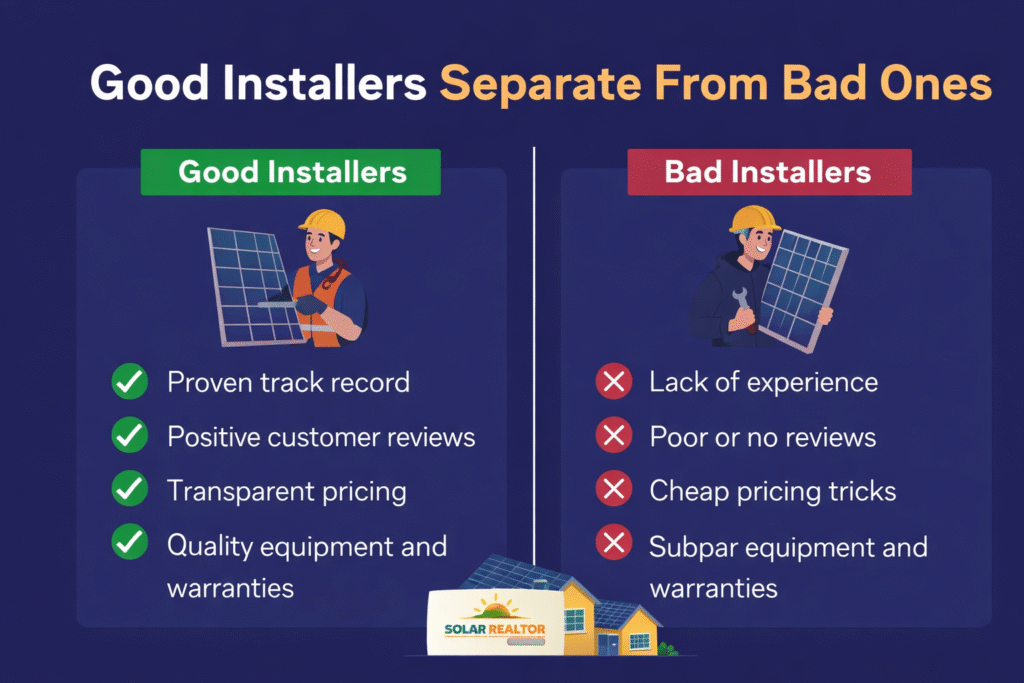
The Financing Conversation: Where Good Installers Separate From Bad Ones
How an installer handles the financing discussion reveals their priorities. A trustworthy installer explains all available options cash purchase, solar loan, lease, and power purchase agreement and helps you understand the true cost and savings under each scenario. They’ll be transparent about interest rates, dealer fees built into loan pricing, and the long-term financial difference between owning and leasing.
A less trustworthy installer steers you aggressively toward whatever financing product gives them the highest commission, often a high-interest solar loan with significant dealer fees baked into the total cost. They’ll quote you a “monthly payment” that sounds attractive without clearly explaining the total amount you’ll pay over the life of the loan.
From our perspective as solar realtors, here’s what we always tell our clients: if you can afford to pay cash or secure a low-interest loan (like a HELOC), owning your system outright provides the best long-term value and makes your home significantly easier to sell in the future. Leases and PPAs have their place for homeowners who don’t qualify for tax credits or can’t afford upfront costs, but they complicate resale and reduce your overall savings.
Ask your installer to provide a side-by-side comparison of total costs under at least two financing scenarios. If they resist this request, they may be hiding unfavorable terms.
Red Flags That Should End the Conversation
Over the years of evaluating solar installations on homes we’re listing or showing, we’ve developed a sharp eye for warning signs. Here are the ones that should make you walk away:
This price is only good today – No legitimate business needs to pressure you into a same-day decision on a major home improvement. If the price is fair today, it will be fair next week.
They can’t or won’t provide references – Any company that’s been in business for more than a couple of years should have satisfied customers willing to vouch for them. Refusal to provide references is a serious red flag.
The salesperson can’t answer technical questions – If the person selling you the system doesn’t understand the difference between a string inverter and a microinverter, or can’t explain how they sized the system for your home, they’re a salesperson first and a solar professional somewhere much further down the list.
They don’t ask about your roof’s age or condition – An installer who’s ready to mount panels without evaluating the roof underneath is either incompetent or doesn’t care about your long-term outcome. Either way, find someone else.
They discourage you from getting competing quotes – A company that’s confident in their value welcomes comparison. A company that’s afraid of comparison has something to hide.
The quote seems dramatically lower than everyone else’s – We’ve said it before and we’ll keep saying it the cheapest solar quote is rarely the best value. Rock-bottom pricing usually means inferior equipment, cutting corners on installation quality, or a company that won’t be around long enough to honor their warranty.
They push a lease or PPA without explaining ownership options – Leases and PPAs can be appropriate for certain situations, but if an installer only offers third-party ownership and won’t discuss purchase options, they’re prioritizing their commission structure over your financial interests.
Questions You Should Ask Every Installer Before Signing
We’ve put together the exact list of questions we’d ask if we were hiring a solar installer today. Bring this to every consultation:
How long has your company been in business, and how many residential installations have you completed?
Do you use your own installation crews, or do you subcontract the work?
If you subcontract, who are the subcontractors, and are they licensed and insured?
Can you provide references from customers whose systems are at least two years old?
Can you show me actual production data from similar systems you’ve installed nearby?
What specific panels, inverters, and racking hardware will you be using on my system? What is your workmanship warranty, and what exactly does it cover?
Who handles warranty claims, your company or the equipment manufacturer?
What happens to my warranty if your company goes out of business?
Do you carry general liability insurance and workers’ compensation?
Can I see a certificate of insurance?
Is anyone on your installation team NABCEP certified?
Will you handle all permitting, utility interconnection, and inspection scheduling?
What is the total cost, and can you break it down by equipment, labor, permitting, and any other line items?
Can you provide a side-by-side comparison of cash purchase versus financed pricing?
What is your estimated timeline from contract signing to system activation?
Any installer worth hiring will answer every one of these questions without flinching. The ones who get uncomfortable, dodge specifics, or redirect toward their sales pitch are telling you everything you need to know.
What We’ve Learned From Selling Solar Homes
Here’s a perspective you won’t get from most guides on how to choose a solar installer we see the downstream consequences of that choice years later, when the home goes on the market.
Homes with well-installed, owned solar systems sell faster and for more money. Research backed by the Department of Energy has found that buyers are willing to pay a significant premium roughly $15,000 on average for a home with a properly installed solar array. But that premium depends entirely on the quality of the installation and the documentation behind it.
When we list a solar home, the first thing we look at is the installation quality and paperwork. Is there a complete record of permits, inspections, and warranty documentation? Is the system performing as specified? Are there any visible signs of poor workmanship irregular panel spacing, exposed conduit runs, improperly sealed penetrations?
The homes that sell easiest are the ones where the original owner hired a reputable local installer, paid for a quality system, kept all the documentation organized, and can point to years of monitoring data showing consistent production. That’s the downstream payoff of choosing your installer carefully right now.
The homes that sit on the market or require price reductions are the ones with leased systems that complicate the transaction, poor installation quality that spooks home inspectors, or installer companies that have gone out of business leaving the homeowner without warranty support.
Your choice of solar installer today is a decision that will follow your home for decades. Make it carefully.
Our Recommended Process: Step by Step
Here’s the exact process we walk our clients through:
Week 1: Research and shortlist – Identify three to five local installers with at least five years in business, positive online reviews, and proper licensing. Ask neighbors with solar who they used and whether they’d recommend them.
Week 2: Request proposals – Contact each installer and request a detailed proposal. Insist on a proper site assessment before accepting any quote.
Week 3: Compare and evaluate – Lay the proposals side by side. Compare system size, equipment, cost per watt, warranty terms, production estimates, and financing options. Call references. Check licensing boards for complaints.
Week 4: Make your decision – Choose the installer that offers the best combination of quality equipment, strong warranties, fair pricing, and demonstrated competence. Sign the contract only after you’ve read every clause and understand the timeline, payment schedule, and cancellation terms.
Months 2-4: Installation and activation – Your installer handles design finalization, permitting, installation, inspection, and utility interconnection. Stay engaged throughout a good installer keeps you informed at every stage.
Final Word
Choosing the right solar panel installer isn’t complicated, but it does require you to be an informed and engaged buyer. The solar industry has plenty of excellent professionals who will treat your home and your investment with the care it deserves. It also has its share of operators who are more interested in their commission than your outcome.
The difference between the two usually becomes obvious when you ask the right questions and pay attention to how they respond. Trust the companies that welcome scrutiny. Be wary of the ones that avoid it.
And if you’re buying or selling a home with solar, or considering adding solar to your property before a sale, we’re here to help you navigate the intersection of solar energy and real estate because that’s exactly where our expertise lives.My Solar Realtor specializes in buying, selling, and listing solar-powered homes. We also offer solar installation services for homeowners looking to add solar before selling or for their own long-term benefit. Visit mysolarrealtor.com to learn more or schedule a consultation.