We’ve helped hundreds of families buy solar homes and install solar systems. Here’s everything we wish every homeowner knew before spending a single dollar on solar.
Between selling solar-equipped homes and helping homeowners get panels installed on their rooftops, we’ve been on both sides of the solar transaction more times than we can count. And if there’s one thing we’ve learned, it’s this: most people overcomplicate the process of buying solar panels for their home.
They get buried in spec sheets, confused by competing sales pitches, and often end up either overpaying or choosing the wrong setup entirely. This guide is our attempt to fix that. We’re going to walk you through the real-world process of how to buy a solar system for home use not the sanitized version you’ll find on a manufacturer’s website, but the honest, sometimes messy truth about what it actually takes to go solar the right way.
First Things First: Does Solar Actually Make Sense for Your Home?
Before you start comparing panel brands or requesting quotes, you need to answer one fundamental question is your home even a good candidate for solar?
Not every house is. And no honest solar professional will tell you otherwise.
Here’s what you need to look at honestly:
Your roof’s condition and age. If your roof needs replacing in the next five to eight years, do that first. Removing solar panels to redo a roof later costs real money typically $1,500 to $5,000 depending on the system size. We’ve seen buyers purchase solar homes only to discover the roof underneath was in rough shape, and the previous owner installed panels partly to delay the conversation. Don’t make this mistake.
How much sun your roof actually gets. South-facing roofs in the Northern Hemisphere get the most direct sunlight. But east and west-facing roofs can still work, especially with modern high-efficiency panels. What kills solar performance is shade from trees, neighboring buildings, or even a chimney casting a shadow across your panels during peak hours. If large portions of your roof are shaded between 9 AM and 3 PM, your output will suffer significantly.
Your electricity bill. Pull out your last twelve months of electricity bills and look at your total annual consumption in kilowatt-hours (kWh). This number drives everything the system size, the number of panels, the cost, and ultimately whether the math works in your favor. If you’re only paying $60 a month in electricity, the payback period on a full solar installation might stretch beyond what’s practical. But if you’re spending $150 to $300 or more, solar starts looking very attractive.
Local regulations and HOA rules. Some municipalities have specific permitting requirements. Some homeowners’ associations have aesthetic guidelines about panel placement. A few states have solar access laws that override HOA restrictions, but it’s worth checking before you get three quotes and fall in love with a design that your HOA won’t approve.
Understanding What You’re Actually Buying
When people ask us how to buy solar panels for your home, most of them think they’re shopping for panels. In reality, you’re buying a complete energy system. The panels are just one piece.
Here’s what a residential solar system actually includes:
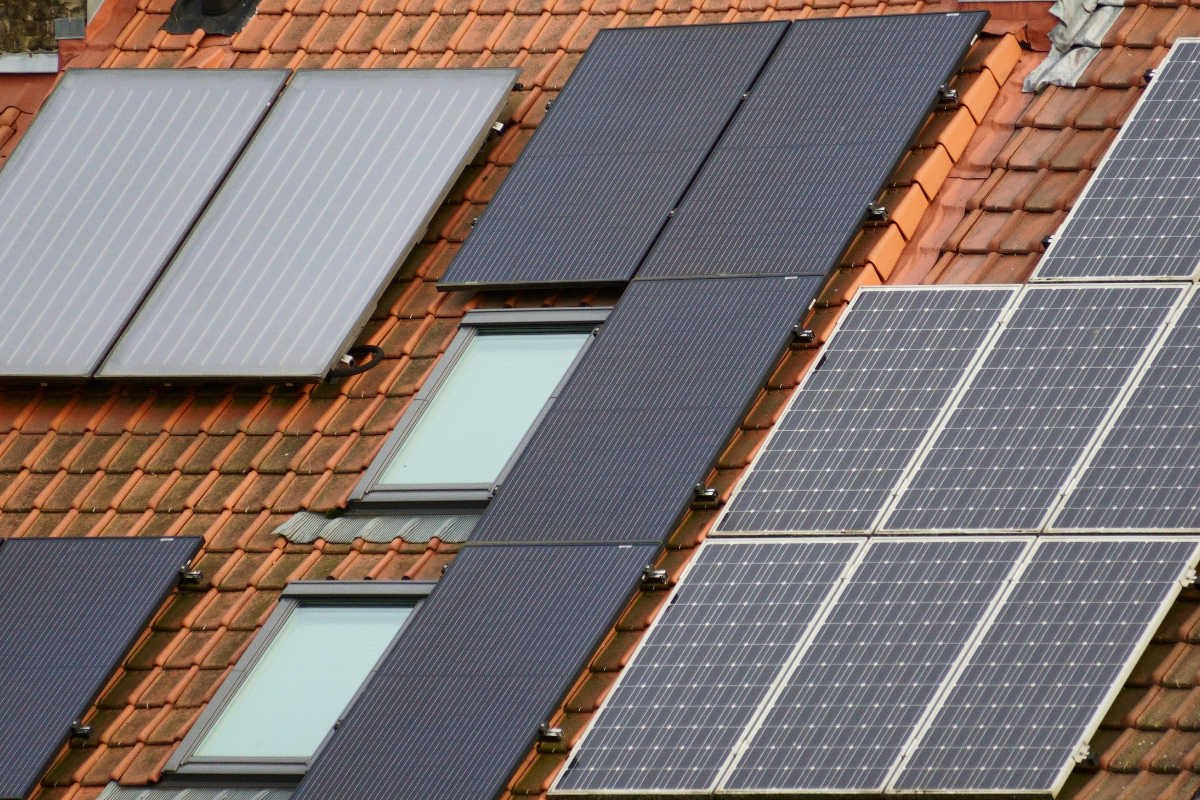
Solar panels (photovoltaic modules). These convert sunlight into direct current (DC) electricity. Modern residential panels typically range from 370 to 440 watts per panel, with most homes needing anywhere from 15 to 30 panels depending on energy consumption and available roof space.
An inverter (or microinverters). Your home runs on alternating current (AC), so you need something to convert the DC power your panels produce. You’ll choose between a string inverter (one central unit that handles all your panels) or microinverters (small units attached to each individual panel). String inverters are less expensive. Microinverters cost more but offer panel-level optimization and monitoring which matters a lot if you have partial shading or panels facing multiple directions.
Racking and mounting hardware. This is what actually attaches the panels to your roof. It needs to be engineered for your specific roof type tile, shingle, metal, or flat and rated for the wind loads and weather conditions in your area.
Electrical components. Wiring, disconnects, meter connections, and everything that ties the system to your home’s electrical panel and the utility grid.
Optional: Battery storage. A battery lets you store excess solar energy for use at night or during power outages. This is becoming increasingly popular, especially in areas where utilities have shifted to time-of-use billing or where net metering policies have become less favorable.
Monitoring system. Most modern installations come with an app or web portal where you can track production, consumption, and system health in real time.
When someone sells you a “solar panel system,” they should be pricing and specifying every one of these components. If a quote just says “20 panels installed for $X” without detailing the inverter type, racking system, and warranty terms for each component that’s a red flag.
The Three Types of Solar Panels: Which One Do You Actually Need?
You’ll encounter three main panel technologies when shopping. Here’s the honest breakdown:
Monocrystalline panels are what most homes end up with, and for good reason. They’re made from a single crystal of silicon, deliver the highest efficiency (typically 20-24%), and perform better in high temperatures and low-light conditions. They’re more expensive per panel, but because they produce more power per square foot, you often need fewer of them. If you have limited roof space, monocrystalline is almost always the right call.
Polycrystalline panels use silicon fragments melted together. They’re cheaper to manufacture and therefore cost less. But they’re also less efficient (typically 15-20%), which means you need more panels to produce the same amount of energy. If you have a large, unshaded roof and budget is a primary concern, polycrystalline can work. But in our experience, the price gap between mono and poly has narrowed so much in recent years that monocrystalline is almost always the better value when you account for the full installed cost.
Thin-film panels are lightweight and flexible, which makes them interesting for unusual roof types or commercial applications. But their efficiency is the lowest of the three (around 10-13%), and they degrade faster. For standard residential rooftop installations, we rarely recommend them.
Within monocrystalline, you might hear terms like PERC, TOPCon, or bifacial. Without getting too deep into the engineering PERC (Passivated Emitter and Rear Contact) has been the standard high-efficiency technology for the past several years. TOPCon (Tunnel Oxide Passivated Contact) is the newer generation, offering slightly better efficiency and lower degradation over time. Bifacial panels can capture light from both sides, which helps when installed over reflective surfaces like white roofing material. For most homeowners, a quality monocrystalline PERC or TOPCon panel from a reputable manufacturer will serve you well for decades.
How to Calculate the Right System Size
This is where many homeowners either get oversold or undersized. Here’s a straightforward method we use with our clients:
Step 1: Find your annual electricity consumption. Check your utility bills for the past 12 months and add up the total kWh. Let’s say you used 10,800 kWh last year.
Step 2: Account for your area’s peak sun hours. “Peak sun hours” doesn’t mean hours of daylight it means the equivalent number of hours when sunlight intensity averages 1,000 watts per square meter. This varies by location. Phoenix might get 6.5 peak sun hours per day. Seattle might get 3.5. New York sits around 4.5. You can find this data from the National Renewable Energy Laboratory (NREL) or your local solar installer should know it well.
Step 3: Do the math. Divide your annual consumption by 365 to get daily use (10,800 ÷ 365 = roughly 29.6 kWh per day). Divide your daily use by your peak sun hours (29.6 ÷ 4.5 = approximately 6.58 kW). Add about 20-25% to account for system losses from inverter conversion, wiring, temperature, and panel degradation over time. That gives you roughly 8 kW of solar capacity needed.
Step 4: Determine the number of panels. Divide the total system size by the wattage of the panel you’re considering. An 8 kW system with 400-watt panels needs 20 panels. With 440-watt panels, you’d need about 18 or 19.
This is a starting point. Your installer should perform a more detailed analysis using satellite imagery of your roof, local weather data, and your specific utility rate structure. But having this rough number in your pocket before you start getting quotes helps you spot when someone is trying to oversell you a system that’s larger than you need.
What to Look for in a Solar Panel: Beyond the Brand Name
After helping people buy solar homes for years, here’s what we’ve learned actually matters when choosing panels:
Efficiency matters, but not as much as you think. The difference between a 21% efficient panel and a 23% efficient panel is real, but it’s not dramatic for most homes. Where it becomes critical is when roof space is limited every percentage point of efficiency means fewer panels needed.
The degradation rate is your long-term performance indicator. All solar panels lose a small amount of production capacity each year. The industry standard is around 0.5% per year, meaning a panel still produces about 87.5% of its original output after 25 years. Premium panels degrade at 0.25-0.3% per year. Over a 25-year span, that difference adds up to meaningful additional energy production.
Temperature coefficient tells you how heat affects output. Solar panels actually perform worse in extreme heat. The temperature coefficient (measured in %/°C) indicates how much output drops for every degree above 25°C (77°F). A coefficient of -0.35%/°C is typical; lower is better. If you live in a hot climate Arizona, Texas, Florida, parts of India this spec matters more than if you’re in a mild climate.
Warranty structure reveals manufacturer confidence. Look for two separate warranties: a product warranty (covering manufacturing defects) of at least 12-15 years, and a performance warranty (guaranteeing minimum output) of 25-30 years. The best manufacturers now offer 25-year product warranties and 30-year performance guarantees. If a company won’t stand behind their panel for more than 10 years on the product side, ask yourself why.
Certifications indicate tested quality. Look for IEC 61215 (performance) and IEC 61730 (safety) certifications at minimum. Additional certifications for salt mist, ammonia, and sand resistance matter if you live in coastal areas, agricultural regions, or desert environments.
How to Choose the Right Solar Installer (This Matters More Than the Panels)
Here’s something we tell every client, and we mean it: the quality of your installation matters more than which brand of panel you pick. A mediocre panel installed perfectly will outperform a premium panel installed poorly every single time.
Get at least three detailed quotes. Not just prices full proposals with equipment specifications, system design drawings, production estimates, and warranty terms. Any installer who quotes you a price without visiting your home (physically or via detailed satellite analysis) doesn’t deserve your business.
Check their track record. How many installations have they completed? How long have they been in business? Can they provide references from installations that are at least two or three years old? A company that’s been around for five-plus years with a solid reputation has proven they’ll be around to honor warranties.
Verify licensing and insurance. Your installer should be licensed to perform electrical work in your state or municipality. They should carry general liability insurance and workers’ compensation. Ask for proof of both. If a worker falls off your roof during installation and the company doesn’t carry workers’ comp, you could be liable.
Ask about their subcontracting practices. Some companies sell solar systems but hire subcontractors to do the actual installation. This isn’t automatically bad, but you want to know who’s actually on your roof and whether the company takes responsibility if the subcontractor makes a mistake.
Look for NABCEP certification. The North American Board of Certified Energy Practitioners (NABCEP) certification is the gold standard for solar installers. Not every good installer has it, but having it on the team demonstrates a commitment to professional standards.
Understand the permitting and interconnection process. A good installer handles all the paperwork building permits, electrical permits, utility interconnection agreements, and incentive applications. If they’re asking you to handle permitting yourself, find someone else.
Understanding the Costs and Financing
Let’s talk money, because this is where most of the confusion (and, frankly, the scams) live.
The current cost landscape. As of 2026, the average residential solar installation in the United States costs roughly $2.50 to $3.50 per watt before incentives. A typical 8 kW system might run $20,000 to $28,000 before tax credits. Prices vary significantly by region labor costs, permitting fees, and equipment preferences all play a role.
The federal solar tax credit. The Investment Tax Credit (ITC) currently provides a 30% credit on the total cost of your solar installation, including equipment, labor, and permitting. This is a dollar-for-dollar reduction in your federal tax liability, not a deduction. On a $24,000 system, that’s $7,200 back. However, you need to have enough tax liability to claim it if you only owe $3,000 in federal taxes, you can carry the remaining credit forward to future years, but you won’t get it as a refund.
State and local incentives. Many states offer additional tax credits, rebates, or performance-based incentives. Some utilities offer rebates as well. The Database of State Incentives for Renewables & Efficiency (DSIRE) is the most comprehensive resource for finding what’s available in your area.
Net metering versus time-of-use rates. Net metering allows you to sell excess solar electricity back to the grid at the retail rate. Time-of-use (TOU) rates charge different prices depending on the time of day. Understanding your utility’s policy is critical because it directly affects your savings calculation. In some markets, like California under NEM 3.0, the value of exported solar electricity has dropped significantly, which changes the battery storage conversation.
Financing options. You’ll generally choose between paying cash, taking a solar loan, or entering a lease or power purchase agreement (PPA). Cash purchase gives you the highest long-term savings. Solar loans let you spread the cost while still owning the system and claiming tax credits. Leases and PPAs mean a third party owns the panels on your roof you typically pay less upfront but save less overall, and transferring the agreement when you sell the home can be complicated.
Speaking from our experience as solar realtors homes with owned solar systems are easier to sell and command a higher premium than homes with leased systems. The Department of Energy has reported that buyers typically pay a premium of around $15,000 for a home with an average-sized owned solar array. Leased systems, on the other hand, can actually slow down a sale because buyers have to qualify to assume the lease.
A Quick Note on Buying a Home With Solar Already Installed
Since we’re solar realtors, this is something we deal with constantly. If you’re considering purchasing a home that already has solar panels, here are the questions you absolutely need answered:
Is the system owned or leased? Owned systems transfer with the property at no additional cost. Leased systems require the buyer to either assume the lease (which requires a credit check) or the seller to buy out the remaining lease balance.
How old is the system? Ask for the installation date and maintenance records. A system that’s been running for 10 years still has 15+ years of life, but you’ll want to verify it’s performing as expected.
What type of inverter is installed, and has it been replaced? String inverters typically last 10-15 years, so they may need replacement before the panels do. Microinverters generally last as long as the panels.
Are the warranties transferable? Most manufacturer warranties transfer to new homeowners, but you need to confirm this in writing. Some installer warranties (workmanship) do not transfer automatically.
What has the actual energy production been? Ask for monitoring data showing real-world output over time. Compare it to the original system estimate. If production has dropped significantly, there may be a maintenance issue.
Check the roof condition underneath. This is non-negotiable. Have a qualified roofer assess the roof around and under the panels before closing.
Red Flags to Watch Out For
Over the years, we’ve seen homeowners get burned by a handful of common practices. Watch out for these:
High-pressure sales tactics. “This price is only good today” or “we only have three spots left in your neighborhood.” Legitimate solar companies don’t need to pressure you into a same-day decision on a $20,000 investment.
Unusually low prices with no detailed breakdown. If one quote comes in at $15,000 while three others are at $22,000-$25,000, that low bidder is either cutting corners on equipment, skipping proper engineering, or pl anning to hit you with change orders later.
Production estimates that seem too good to be true. If an installer’s proposal shows 20% more production than competitors for the same system size, they may be using aggressive assumptions. Ask what solar irradiance data they’re using and what efficiency losses they’ve factored in.
Door-to-door sales pitches. While not all door-to-door solar salespeople are dishonest, this channel has historically produced the most complaints, the highest prices, and the most aggressive financing terms. If someone knocks on your door selling solar, take their information and do your own research before signing anything.
Contracts with hidden escalator clauses. Some lease and PPA agreements include annual price increases of 2-3%. Over 20 years, that adds up. Read every line before you sign.
Our Step-by-Step Process for Going Solar
Here’s the practical roadmap we recommend to every homeowner who’s serious about buying a solar panel system for their home:
Month 1: Research and preparation. Calculate your energy usage. Research available incentives. Understand your utility’s net metering policy. Check your roof age and condition. Review any HOA requirements.
Month 1-2: Get quotes and compare. Request proposals from at least three reputable installers. Compare system designs, equipment specifications, production estimates, warranty terms, and total costs including financing. Don’t just pick the cheapest pick the best value.
Month 2: Make your decision. Choose your installer. Sign the contract. Apply for financing if applicable. Your installer should handle the initial permit applications.
Months 2-3: Design and permitting. Your installer finalizes the system design, submits for building and electrical permits, and coordinates with your utility for interconnection approval. This phase is where delays most commonly happen some municipalities take weeks, others take months.
Months 3-4: Installation. The actual installation typically takes one to three days for a standard residential system. After installation, a building inspector needs to approve the work before the system can be activated.
Months 4-5: Utility inspection and activation. Your utility inspects the installation and installs a bi-directional meter (if needed). Once they grant Permission to Operate (PTO), you flip the switch and start generating your own electricity.
The entire process from signing a contract to generating power typically takes 60 to 120 days, with permitting being the biggest variable.
Final Thoughts From Someone Who Lives and Breathes Solar Real Estate
Going solar is one of the smartest financial and environmental decisions a homeowner can make when it’s done right. The key word there is “right.” A poorly designed system, a shady financing deal, or a fly-by-night installer can turn what should be a 25-year asset into a headache.
Take your time. Do the math with your own numbers, not the installer’s projections. Verify everything. And if you’re buying or selling a solar home, work with a realtor who actually understands solar energy systems, not one who treats the panels as just another roof feature.
At My Solar Realtor, we specialize in exactly this. Whether you’re looking to buy a solar home, sell one, or add solar to your current property, we bring the real estate expertise and the solar industry knowledge together so you can make confident decisions.
Got questions about how to buy solar panels for your home? Want help evaluating a solar home you’re considering purchasing? We’re here for that conversation.
My Solar Realtor is a specialized real estate firm focused on solar-powered homes. We buy, sell, and facilitate solar home transactions and also offer solar installation services. Visit mysolarrealtor.com to learn more or get in touch.